How to measure small aquarium doses: 0.1 mL, 0.25 mL and 0.5 mL
By Richard James · Manufacturer sources reviewed 28 October 2026
Use a liquid-measuring device with markings and stated performance suitable for the required amount. Check its units, scale and reading instructions. A printed decimal in a calculator does not mean a cap, kitchen spoon or every 1 mL syringe can measure it reliably.
Jump to a section
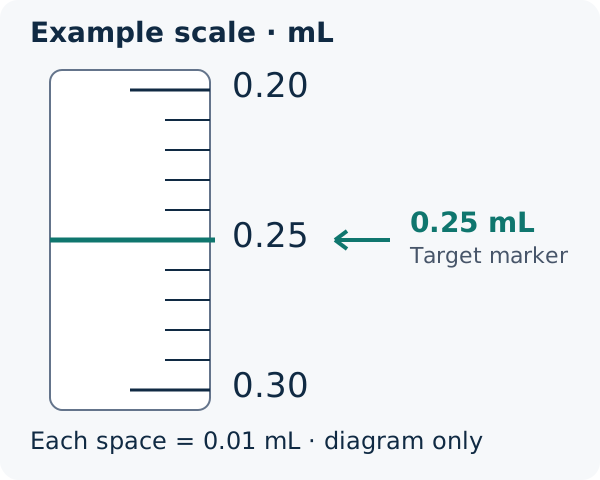
Walkthrough: locate 0.25 mL on an example scale
Scale-reading exercise · not a dose recommendation
This is a constructed diagram, not a tested syringe. The close-up deliberately shows ten equal spaces between 0.20 and 0.30 mL. Your device may be marked differently.
- 1
Confirm the unit and the required amount
Read mL, not mg or insulin units. In this exercise the target is 0.25 mL. Do not use this example amount as a product instruction.
- 2
Count the spaces between labelled marks
Here: (0.30 − 0.20) ÷ 10 = 0.01 mL per space. A different number of spaces changes the answer; do not assume every small syringe has this scale.
- 3
Use the device’s specified reading point
Check its instructions for which edge or reference to align, then read at eye level. Plunger shapes differ. Address air bubbles and filling/delivery technique according to that device’s instructions; the coloured line here is only a target marker.
- 4
Recheck before delivery
Compare the unit, decimal and applicable calculated amount again. Use a suitable needle-free liquid dispenser and keep equipment designated for aquarium use. If its documented measuring performance does not support the amount, obtain a suitable method rather than guessing.
Try it: what if 0.20 to 0.30 has only five spaces?
Each space is 0.02 mL: (0.30 − 0.20) ÷ 5 = 0.02. That scale has no graduation exactly at 0.25 mL. Do not claim an accurate 0.25 mL measurement just by guessing halfway; check the device’s suitability or ask for a supported measuring method.
Practise with water first
For a dry run, use clean water and equipment compatible with it, away from the aquarium and product bottle. Follow the device’s filling and dispensing instructions. This familiarises you with the controls; it does not calibrate the device. Do not return practice liquid to a product bottle or use it to improvise a medicine dilution.
First check: can the scale show your amount?
Look at two neighbouring labelled marks. Subtract the lower value from the higher, then divide by the number of equal spaces between them. Count spaces, not tick marks.
If 0.1 mL and 0.2 mL are separated by ten equal spaces, each space represents 0.01 mL. If they are separated by five, each represents 0.02 mL. The syringe capacity alone does not identify its graduations.
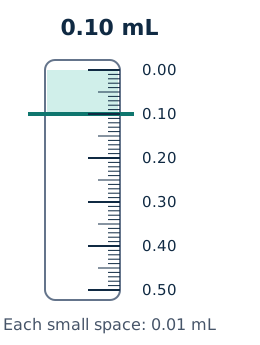
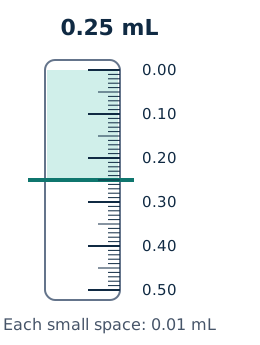
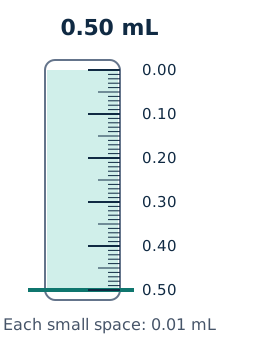
Original teaching diagrams, not photographs of tested syringes. Follow your device’s scale and specified reading point.
Worked examples for a 0.01 mL scale
| Required volume | Position on this example scale | Check |
|---|---|---|
| 0.10 mL | The 0.10 mark. | Not 1.0 mL: that would be ten times as much. |
| 0.25 mL | Five 0.01 mL spaces beyond 0.20. | A 0.1 mL-only scale does not mark this position. |
| 0.50 mL | The 0.50 mark. | Read the device's specified plunger reference point. |
These examples explain a scale. They do not certify a device's accuracy or recommend a product amount.
Fine markings are not an accuracy guarantee
Syringe manufacturer Hamilton specifies performance under defined conditions, including a test point at 80% of nominal volume. That specification must not be applied to an untested aquarium syringe or every position on its scale. Read your actual device's documentation, including the minimum useful quantity and correct handling.
- Confirm the required unit is mL, not mg, drops or an insulin-unit scale.
- Use a suitable needle-free liquid dispenser; check material compatibility and the device instructions.
- Read at eye level using the specified plunger reference point. Address bubbles according to the device instructions.
- Measure and deliver as instructed. Keep equipment labelled for aquarium use and avoid contaminating another bottle.
What if the amount is too small?
Do not round upward simply to reach an easy mark. Find equipment suitable for the quantity or ask the product manufacturer for an approved measuring method. Do not improvise a dilution or store a premixed medicine without explicit product instructions.
Check the exact product calculator and read its measurement units before drawing up the liquid. Drops per millilitre are product- and dispenser-specific; a generic drop conversion is not a workaround.
Common questions
Is 0.1 mL the same as 1 mL?
No. 0.1 mL is one tenth of 1 mL. Keeping the leading zero helps prevent a decimal-reading error.
Can I use a bottle cap for 0.25 mL?
Only if its documented graduations and performance support that quantity. Do not estimate an unmarked fraction of a cap.
Does a smaller syringe always solve the problem?
No. Check the scale, accuracy specification, compatibility and intended operation. Capacity is only one part of choosing equipment.
Sources and review scope
- Hamilton syringe accuracy FAQ — why published accuracy has defined test conditions
- Hamilton care and use guide — device-specific handling and documentation
Reviewed 28 October 2026. Manufacturer statements are attributed above; examples and checklists are DoseMyTank explanations. This is not an independent test of efficacy, a diagnosis or a substitute for the supplied instructions. If your bottle differs, resolve the difference with its manufacturer before dosing.